Bahasa Indonesia
 English

orkshop on TKA Preparation Support and Strengthening Students’ Mathematical Disposition for Junior High School Mathematics Teachers in Kulon Progo, Yogyakarta
Submitted by irfan on Thu, 07/30/2026 - 00:00

KULON PROGO – The Community Service and Empowerment (PPM) Team of the Mathematics Education Department (Depdikmat), Faculty of Mathematics and Natural Sciences (FMIPA), Universitas Negeri Yogyakarta (UNY), led by Husna Arifah, M.Sc., organized a Workshop on Academic Competency Test (TKA) Preparation Support and Strengthening Students’ Mathematical Disposition. The activity was conducted through an in-person mentoring session on Thursday, July 23, 2026, an online mentoring session on Wednesday, July 29, 2026, and structured assignments for the participants.
The workshop was attended by 30 mathematics teachers who are members of the Junior High School Mathematics Subject Teachers’ Forum (MGMP) in Kulon Progo Regency. It aimed to equip educators with effective strategies for supporting students in preparing for the TKA while enhancing teachers’ skills in developing students’ mathematical disposition. Mathematical disposition encompasses a positive attitude toward mathematics, self-confidence, perseverance, curiosity, and the willingness to persist when facing mathematical challenges.
Strengthening teachers’ competencies and students’ mathematical disposition through this activity is part of an effort to support the achievement of the Sustainable Development Goals (SDGs), particularly SDG 4: Quality Education. SDG 4 emphasizes the importance of inclusive and quality education that provides learners with opportunities to develop the knowledge and skills needed for life. In this context, enhancing teacher capacity is not limited to improving students’ academic achievement but also focuses on developing learning attitudes, resilience, and motivation that support lifelong learning.
The first agenda, held on July 23, 2026, took place at SMP Negeri 1 Pengasih and consisted of three presentation sessions. The activity opened with remarks from Sudaryanta, S.Pd., Chair of the Junior High School Mathematics MGMP of Kulon Progo Regency. The first session featured Nila Mareta Murdiyani, S.Pd., M.Sc., who presented “Strengthening Mathematical Disposition.” This topic was particularly important given that Mathematics TKA performance in Indonesia, including in Kulon Progo, still requires continuous evaluation and improvement. Academic achievement depends not only on mastery of subject matter but also on students’ attitudes when facing challenges in learning mathematics.
Through strengthening mathematical disposition, teachers were encouraged to foster positive attitudes, resilience, self-confidence, and students’ willingness to keep trying when encountering difficulties. This approach is expected to create more meaningful learning experiences while providing students with opportunities to develop according to their potential. It is also in line with the spirit of SDG 4, which places the quality of the learning process and the development of students’ competencies as important components of sustainable educational development.
The second session continued with “Optimizing Learning and Assessment in Preparing for the Academic Competency Test (TKA),” delivered by Husna Arifah, M.Sc. During this session, participants were invited to engage in an in-depth reflection on students’ current achievements. One of the discussion questions was whether students’ TKA results in Kulon Progo had so far reached the expected level. This reflection served as a starting point for educators to evaluate the learning and assessment practices they had implemented. Teachers were then encouraged to design more effective and contextual learning and assessment activities that could provide a more comprehensive picture of students’ abilities. Thus, assessment would not merely function as a tool for measuring learning outcomes but also as a basis for improving the learning process and providing support tailored to students’ needs.
The third session featured Heru Sukoco, S.Si., M.Pd., who presented “Teachers’ Attitudes toward Mathematics Teaching.” The session provided insights into the importance of teachers’ attitudes in creating positive mathematics learning experiences. Teachers were encouraged to recognize that students’ perceptions and attitudes toward mathematics can be influenced by how teachers perceive and teach mathematics in the classroom. Through this session, participants were encouraged to create learning environments that are more welcoming, supportive, and inspiring, while providing students with opportunities to ask questions, try new approaches, and learn from mistakes. Such learning environments are expected to increase student engagement and help them develop a more positive relationship with mathematics.
The workshop series continued with an online session on July 30, 2026, featuring Endah Retnowati, Ph.D., who presented “Students’ Learning Motivation.” The session began with reflective questions, including “How motivated are teachers to teach mathematics?” and “How motivated are students to learn mathematics?” The discussion then focused on strategies for motivating students through the implementation of motivational prompts. This strategy is designed to help teachers build more meaningful learning interactions and encourage students to actively engage in the learning process.
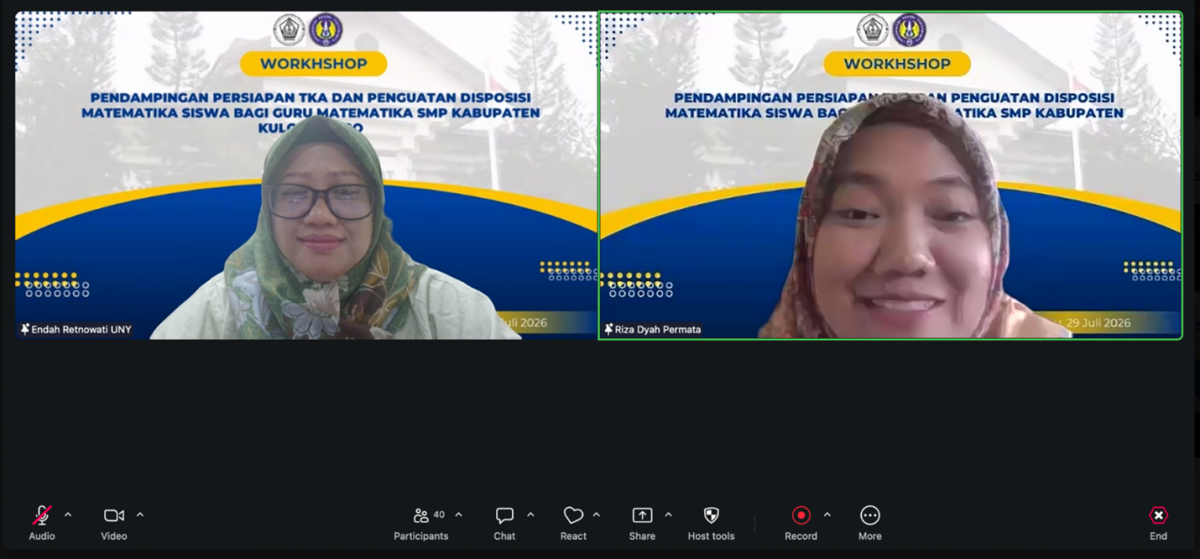
The series of mentoring activities, presentations, discussions, and structured assignments is expected to go beyond increasing teachers’ knowledge and lead to concrete implementation in their respective schools. Teachers are expected to apply more effective learning and assessment strategies while continuously fostering students’ mathematical disposition and learning motivation. Through this PPM DLK activity, the Mathematics Education Department of FMIPA UNY contributes to supporting SDG 4 through strengthening educator capacity and improving the quality of mathematics education. Enhancing teachers’ competencies is expected to have a sustainable impact on the quality of learning experiences among junior high school students in Kulon Progo Regency.
Ultimately, educational success should not be measured solely by students’ readiness to take the TKA or their academic scores, but also by the development of a generation with resilience, self-confidence, learning motivation, critical thinking skills, and positive attitudes toward mathematics. These efforts represent an important part of building a high-quality and sustainable education ecosystem, in line with the vision of SDG 4: Quality Education.
Label Berita:
Akreditasi
Sertifikat akreditasi dapat diunduh disini
Kontak Kami
Program Studi Pendidikan Matematika
(Gedung Baru FMIPA lt III depan Masjid Mujahidin Karangmalang)
FMIPA Universitas Negeri Yogyakarta
Kampus Karangmalang Yogyakarta 55281
email: pmatematika@uny.ac.id