Bahasa Indonesia
 English

Strengthening Senior High School Mathematics Teachers’ Competence: UNY PkM Team Holds Workshop on Statistics and Probability and TKA-Oriented Question Development
Submitted by irfan on Wed, 08/12/2026 - 00:00

MAGELANG – The Community Service (PkM) Team from the Mathematics Education Study Program, Universitas Negeri Yogyakarta (UNY), led by Prof. Dr. Kana Hidayati, M.Pd., together with team members Dr. Elly Arliani, M.Si., and Husna Arifah, M.Sc., in collaboration with the Mathematics Subject Teachers’ Forum (MGMP) of Senior High Schools in Magelang Regency, organized a Workshop on Statistics and Probability Content Enrichment and Academic Competency Test (TKA)-Oriented Question Development. The workshop was conducted online on August 5, 2026, and continued with an in-person session on August 12, 2026, at SMA Negeri 1 Muntilan. The workshop was attended by 40 senior high school mathematics teachers from Magelang Regency.
The activity aimed to strengthen the professional competence of mathematics teachers in developing TKA-oriented questions, particularly on statistics and probability, while supporting teachers’ readiness to assist students in preparing for the TKA. In addition, the activity was designed to encourage innovative and contextual mathematics learning that aligns with curriculum needs.
The workshop also represented UNY’s contribution to supporting the achievement of the Sustainable Development Goals (SDGs), particularly SDG 4: Quality Education. Enhancing teacher competence is an important foundation for creating high-quality, inclusive, and relevant learning processes that meet students’ needs. By strengthening teachers’ abilities to understand concepts, design assessments, and develop questions that require logical and analytical thinking, the activity is expected to contribute sustainably to improving the quality of mathematics education in schools.
The online session began with remarks from the Chair of the Mathematics MGMP of Senior High Schools in Magelang Regency, Sutrasno, S.Pd., who expressed his appreciation for UNY’s proactive efforts to support teacher professional development. He expressed hope that the workshop would benefit teachers in guiding students to prepare for the TKA and ultimately contribute to improving students’ academic achievement. The next remarks were delivered by Prof. Dr. Kana Hidayati, M.Pd., Chair of the UNY PkM Team, who encouraged participants to actively develop their competencies through content enrichment and TKA-oriented question development.
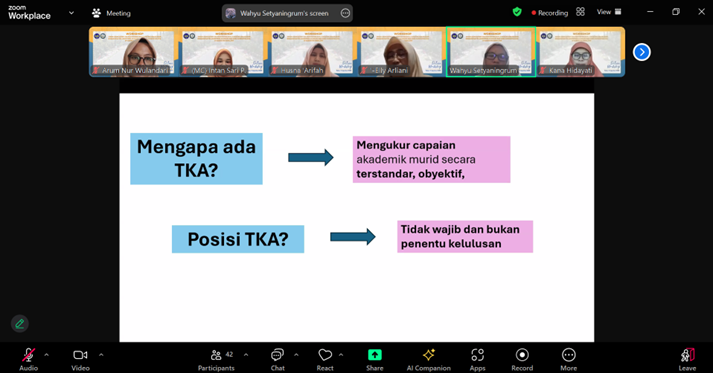
In the first session, Prof. Wahyu Setyaningrum, S.Pd., M.Ed., Ph.D., who is also actively involved with the Center for Educational Assessment (Pusmendik) of the Ministry of Education, Culture, Research, and Technology, presented material on TKA policies and their implementation. She explained several changes in the 2026 TKA regulations and policies compared with those of 2025. Participants enthusiastically followed the presentation, which focused on the TKA Mathematics framework, including content, context, and cognitive levels.
The second session was led by Dr. Amran Hapsan, S.Si., S.Pd., M.Pd., a mathematics education practitioner, who presented tips and strategies for preparing for the Senior High School/Vocational High School/Islamic Senior High School Mathematics TKA, particularly in statistics and probability. He emphasized the importance of fostering students’ enjoyment of mathematics as one of the factors supporting successful learning. Participants were also invited to explore examples of statistics and probability problems that appeared in the 2025 TKA through techniques involving modification and visualization of mathematical concepts.
According to him, students’ success in taking the TKA is determined not only by their ability to memorize formulas but also by their conceptual understanding, ability to comprehend contextual problems, mastery of various problem-solving strategies, time efficiency, and logical and analytical thinking skills. This approach is consistent with efforts to promote quality education that equips students with competencies for addressing various real-life problems.
The third session focused on techniques for developing TKA-oriented questions and was facilitated by Prof. Dr. Kana Hidayati, M.Pd. She explained that the TKA offers various benefits, including serving as an academic diagnostic tool to identify students’ conditions more accurately, as a selection and prediction instrument, and as part of learning quality assurance. As the frontline professionals in the learning process, teachers play a strategic role in ensuring that learning activities are aligned with assessment requirements and students’ needs. Therefore, the ability to develop TKA-oriented questions is essential so that teachers can gradually familiarize students with various types of problems. This competency also supports teacher professionalism in aligning content, context, and cognitive levels to produce high-quality assessments.
In the final online session, Dr. Elly Arliani, M.Si., delivered material on developing TKA-oriented questions in statistics and probability. She presented various topics, indicators, cognitive levels, and examples of TKA-oriented questions. Teachers were also encouraged to provide solution explanations based on underlying concepts so that students would not merely obtain answers but also understand the thinking processes behind them. The workshop then continued with a group assignment in which participants developed TKA-oriented questions. The resulting questions were subsequently presented and discussed during the in-person meeting.
The in-person workshop on August 12, 2026, began with remarks from the Principal of SMA Negeri 1 Muntilan, Beny Sukandari, M.Pd.B.I. He warmly welcomed the UNY PkM Team and expressed his hope that the outcomes of the workshop could be effectively implemented by the participants in their respective schools.
The activity continued with an in-depth discussion of statistics and probability led by Dr. Djamilah Bondan Widjajanti, M.Si. Several statistics and probability problems were presented as part of the content enrichment for the participating teachers. In her presentation, she also provided recommendations for teaching statistics and probability, including avoiding starting lessons with definitions and formulas; using diverse and realistic contexts; emphasizing relational or conceptual understanding rather than merely procedural or instrumental understanding; utilizing data sources from the internet; using appropriate software; and providing students with opportunities to explore data.
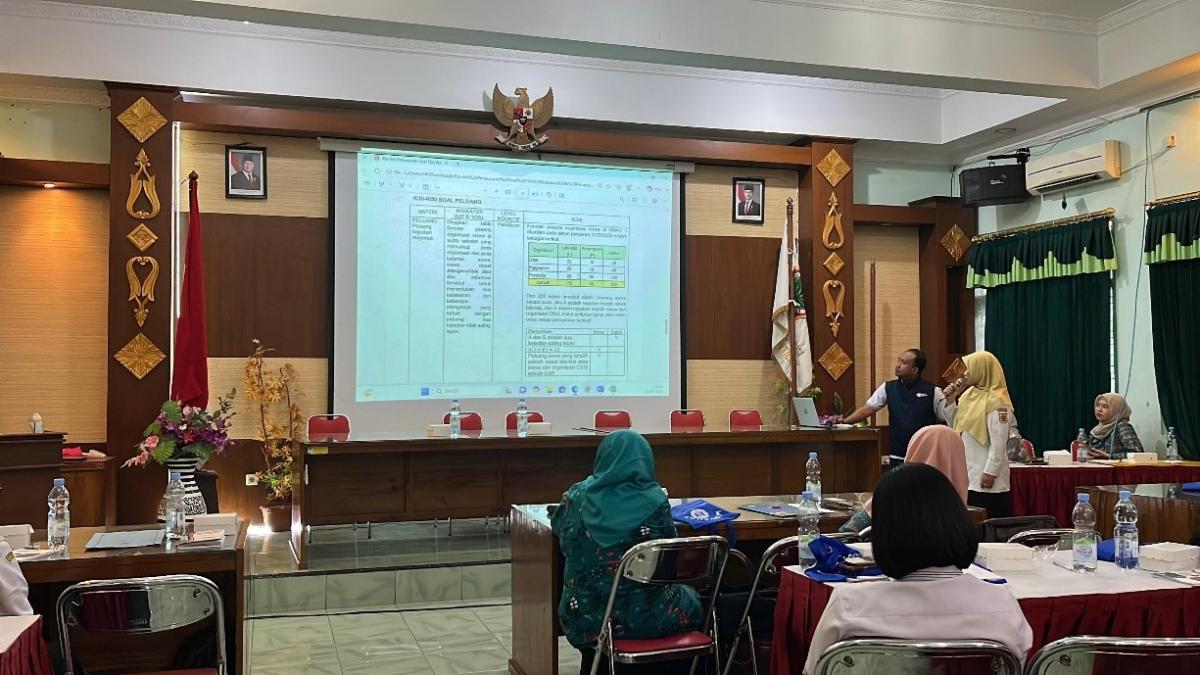
The in-person session concluded with presentations of the TKA-oriented question development assignments by participant representatives, followed by an evaluation by the PkM Team. The workshop participants expressed positive impressions of the activity, particularly the material on statistics and probability, areas in which students’ achievement in the 2025 TKA was still relatively low. Therefore, the activity is expected to encourage teachers to further strengthen their competencies in guiding students toward better TKA performance.
Label Berita:
Akreditasi
Sertifikat akreditasi dapat diunduh disini
Kontak Kami
Program Studi Pendidikan Matematika
(Gedung Baru FMIPA lt III depan Masjid Mujahidin Karangmalang)
FMIPA Universitas Negeri Yogyakarta
Kampus Karangmalang Yogyakarta 55281
email: pmatematika@uny.ac.id