Bahasa Indonesia
 English

Enhancing Mathematics Teachers’ Pedagogical Content Knowledge through Mathematics Lesson Study in Wonosobo Regency
Submitted by irfan on Thu, 10/15/2026 - 00:00

On Wednesday, August 5, 2026, a training workshop for junior high school mathematics teachers across Wonosobo Regency was held at SMP Negeri 1 Sapuran, Wonosobo. The activity was initiated by the Community Service (PkM) team of the Teacher Professional Development Research Group (KBK), consisting of Tuharto, M.Si., Dr. R. Rosnawati, M.Si., Caturiyati, M.Si., and Prof. Dr. Ariyadi Wijaya, M.Sc. The event ran from 8:30 a.m. to 3:00 p.m. and was attended by 28 mathematics teachers from 20 junior high schools across Wonosobo Regency. The community service program, entitled “Enhancing Mathematics Teachers’ Pedagogical Content Knowledge through Mathematics Lesson Study in Wonosobo Regency,” was conducted in collaboration with Mathematics Subject Teachers’ Working Group (MGMP) Working Group 3, which covers the districts of Sapuran, Kepil, and Kalibawang in Wonosobo Regency, Central Java.
The objective of this community service program was to improve the competencies of junior high school mathematics teachers through training in the implementation of lesson study. The activities included collaborative lesson planning through focus group discussions (FGDs) to design a Grade VII mathematics lesson on number patterns using object configurations; an open class, in which a model teacher conducted a lesson observed by other junior high school mathematics teachers; and reflection on the observations of the lesson implementation to improve the lesson plan.
Lesson study can be regarded as a cycle of instructional improvement because it engages teachers in active learning about subject matter, guided by data and clear objectives. It is also a continuous, intensive, collaborative, and practice-based process that makes different types of knowledge more visible. Through lesson study, teachers can learn to design and implement discovery-based lessons that are expected to foster deeper understanding and develop active learning habits through independent discovery and investigation. Consequently, the knowledge acquired by students is expected to be retained longer.
The training was conducted over several sessions. The first session focused on discussing the learning materials, selecting the model teacher for the Do stage, and discussing the learning materials and instructional tools that needed to be prepared. This face-to-face meeting was attended by the KBK team, MGMP administrators, the prospective model teacher, and several other teachers. It took place in Tambi, Sapuran District, Wonosobo Regency.
The second session was conducted in a hybrid format and focused on designing the lesson plan (Plan). The teachers met in person, while the FGD with the KBK team was conducted online. The FGD aimed to examine the effectiveness of the proposed discovery-based lesson design and the learning processes involved, including the breadth and progression of learning, the design of learning activities based on discovery principles, and the challenges encountered when implementing guided discovery learning.
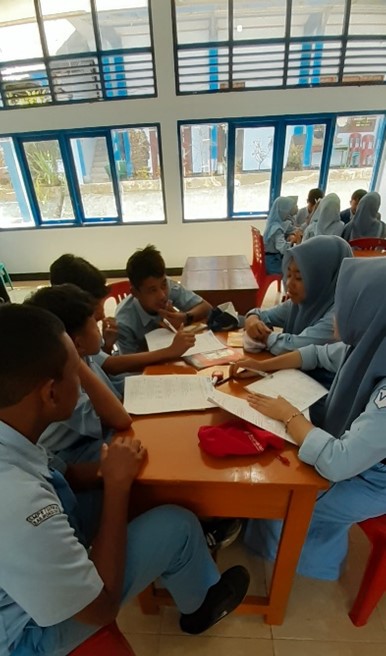
The third session consisted of an open class (Do), held face-to-face at SMP Negeri 1 Sapuran, Wonosobo. The session was attended by 28 junior high school mathematics teachers from three districts in southern Wonosobo. Sri Wahyuni, S.Pd., from SMP Negeri 1 Sapuran, served as the model teacher.
 ;
; ;
;

Open Class (DO) Atmosphere
The See stage, an essential component of lesson study, involved reflecting on the teaching and learning activities that had taken place. The reflection session was facilitated by Tuharto, M.Si., and Dr. R. Rosnawati, M.Si. Participants enthusiastically shared their classroom observations and provided suggestions for improving subsequent lessons.

An Atmosphere of Reflection (See)
The reflections provided valuable input for all participating teachers in designing guided discovery lessons that are expected to promote deeper understanding and encourage active learning through independent discovery and investigation. This approach is expected to help students retain their learning for a longer period. It is also aligned with Indonesia’s Kurikulum Merdeka (Independent Curriculum), which supports deeper learning. (Caturiyati)
Label Berita:
Akreditasi
Sertifikat akreditasi dapat diunduh disini
Kontak Kami
Program Studi Pendidikan Matematika
(Gedung Baru FMIPA lt III depan Masjid Mujahidin Karangmalang)
FMIPA Universitas Negeri Yogyakarta
Kampus Karangmalang Yogyakarta 55281
email: pmatematika@uny.ac.id